
⏰ 5-6 min.
Field sales in convenience retail plays an increasingly critical role in how brands convert distribution into sustainable growth. While the UK convenience channel remains essential to the grocery landscape, its maturity introduces new execution challenges that directly impact performance.
Convenience retail delivers immediacy, frequency and local relevance for shoppers, while giving brands access to thousands of distribution points nationwide. However, as the channel evolves, converting that reach into consistent growth depends less on national strategy and more on what happens in store.
In this context, field sales teams support growth by translating brand ambition into shelf‑level reality, improving availability, visibility and consistency at the moments when shopper decisions are made.

The Macro and Micro Environment of the UK Convenience Channel
A mature but resilient retail market
At a macro level, the UK convenience sector continues to demonstrate resilience. In 2025, the channel generated approximately £49.2bn in sales in 2025, and is forecast to grow to £56.2bn by 2030, equating to a projected 2.7% CAGR. This outlook reflects ongoing demand driven by lifestyle changes, urban density and the shift towards local shopping. However, recent performance highlights the realities of a mature channel. Annual growth of around 1.0–1.3% in 2025 signals a low‑growth, high‑competition environment, where incremental improvements increasingly determine success . Consequently, execution plays a greater role in delivering commercial outcomes.
Growth in convenience retail is driven by frequency and missions
Convenience growth relies on frequency rather than basket expansion. Shoppers visit more often but purchase fewer items per trip. Therefore, brands must win individual occasions rather than rely on increased spend per visit. According to Lumina Intelligence, convenience trips typically fall into a small number of repeatable missions, including immediate consumption, top‑up shopping, meal solutions for later the same day, and impulse or distress purchases. Because these missions cut across multiple categories, they reward products that shoppers can find quickly and easily. As a result, availability and relevance become decisive growth drivers.
Fragmentation at store level
At a micro level, complexity increases sharply. The UK convenience channel consists of multiples convenience, symbol groups, unaffiliated independents and forecourts, each operating under different systems and constraints. According to the Association of Convenience Stores, 71% of convenience stores are operated by independent retailers, either unaffiliated or part of a symbol group, while multiples convenience continues to drive the fastest growth. This fragmentation creates significant variation in execution. Stores operate with limited shelf space, constrained back‑of‑house capacity and store teams juggling multiple operational priorities. As a result, availability frequently suffers.
Research from Retail Economics and DHL Supply Chain shows that on‑shelf availability in convenience stores typically sits in the low‑to‑mid 80% range, compared with 90%+ in supermarkets. The commercial impact is significant:
- 1 in 5 UK grocery trips involves a missing item
- This equates to approximately £2.1bn in displaced sales annually
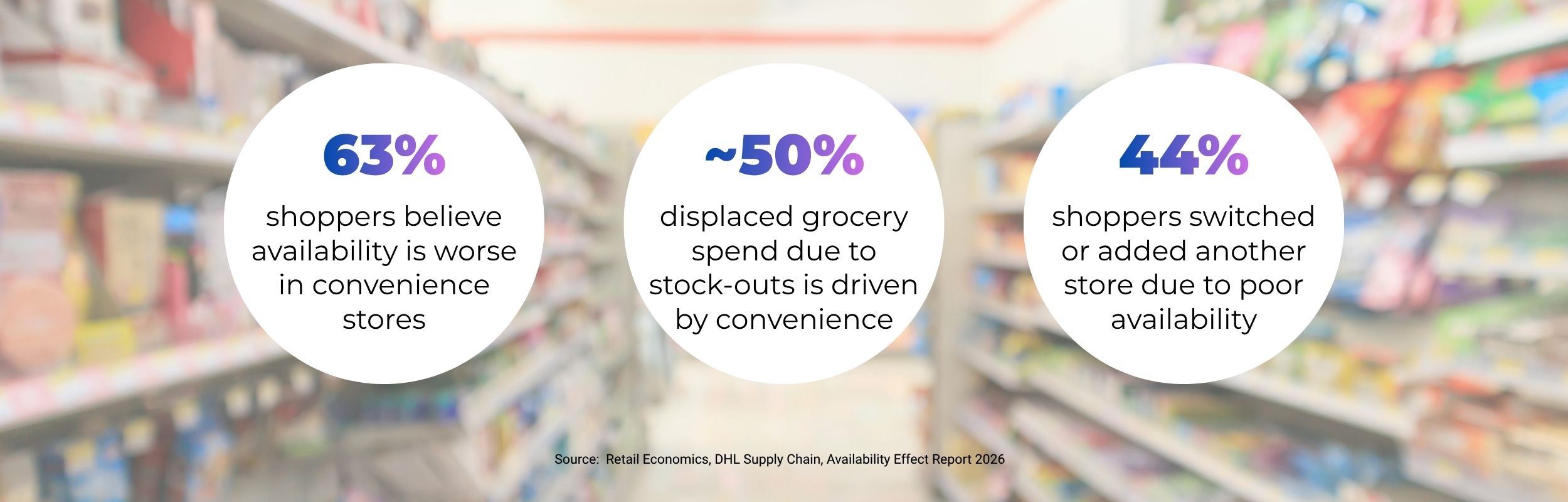
- Convenience accounts for around 20% of grocery sales, but nearly 50% of displaced spend caused by stock‑outs
- 63% of shoppers believe availability is worse in convenience stores
Taken together, these figures underline a clear conclusion: growth in convenience depends on execution quality at store level.
Field Sales Capabilities in the Convenience Channel
Field sales teams operate at the intersection of brand strategy and store reality. Their value lies in turning priorities into action across diverse retail environments.
1. Improving availability under real operating conditions
Field sales teams work within the everyday constraints of convenience retail. They help stores prioritise core lines, align stock levels with shopper demand and address recurring out‑of‑stock issues. Crucially, regular presence allows field teams to identify risks early and prevent small gaps from becoming persistent problems. Over time, this stabilises availability and protects lost sales.
2. Strengthening visibility at the point of purchase
Convenience shoppers make fast decisions. Therefore, visibility must align with real shopper movement and mission fulfilment. Field sales teams help maintain facings, protect shelf position and ensure products sit where shoppers naturally look and reach. As a result, brands convert availability into actual purchase more effectively.
3. Adapting execution by store format
Each convenience format presents different challenges. Multiples convenience prioritises consistency at scale, while symbol and independent stores require flexibility. Field sales teams adapt execution by format, tailoring activity to store capability, layout and shopper profile rather than applying a single national execution model. This adaptability allows brands to perform consistently across a fragmented estate.
4. Building trusted store relationships
Relationships matter in convenience retail. Field representatives build trust by offering practical support, understanding individual store pressures and maintaining consistent contact. Consequently, store owners and managers are more likely to sustain agreed standards between visits. Over time, these relationships improve compliance, execution discipline and long‑term performance.
How Field Sales Closes Availability Gaps in Convenience Retail
Availability gaps rarely stem from a single failure. Instead, they emerge through small execution issues that accumulate over time. Field sales teams close these gaps through targeted, store‑level actions, including:
- Identifying lines repeatedly affected by out‑of‑stocks
- Supporting correct ranging of core SKUs
- Protecting facings from gradual erosion
- Supporting promotional execution during peak periods
- Aligning shelf execution to high‑frequency shopper missions
Because field sales operates store by store, it reduces performance variation across the estate. As a result, brands protect sales more consistently and create a more reliable shopper experience.
Key Takeaways
- Convenience growth is incremental and execution‑led. With low basket sizes and modest channel growth, brands win by improving performance at store level rather than relying on scale alone.
- Availability is the biggest commercial risk in convenience retail. Stock‑outs disproportionately impact convenience stores, and even small gaps redirect spend quickly. Therefore, protecting availability directly protects growth.
- The channel’s fragmentation increases performance variation. Independents, symbol groups, multiples convenience and forecourts operate under different constraints, which means execution quality varies widely from store to store.
- Field sales teams stabilise performance where systems cannot. By working in store, field sales reduces availability gaps, protects visibility and addresses execution issues before they translate into lost sales.
- Local relationships drive consistency over time. Trusted relationships between field reps and store owners improve compliance, reinforce priorities and sustain execution between visits.
- Growth is won at the shelf, not at head office. In convenience retail, field sales turns strategy into outcomes by ensuring products remain available, visible and relevant when shoppers make fast decisions.