
The European toy category is not short of innovation. However, despite many NPDs securing initial listings, a significant proportion struggle to sustain performance beyond the early stages of retail. This reflects a broader shift in the retail environment, where growth across Europe has stabilised but remains constrained and uneven between markets. Retail turnover slowed to around +3.0% in 2024 (vs. +5.5% in 2023), while household consumption across Europe has grown only modestly, reflecting a more cautious and selective demand environment.
As a result, execution is no longer just a contributor to NPD success, it is increasingly what determines it. Slower growth and increased scrutiny from retailers mean that launches must demonstrate traction quickly to maintain support and scale. For brands, success depends less on the volume of innovation and more on the ability to deliver consistent availability, visibility and activation across markets in the first weeks.

High pressure and variability of the toy market
The European toy market operates within a highly seasonal and structurally complex environment. Demand is concentrated around key trading periods, growth is uneven across segments, and performance is heavily influenced by in-store execution across fragmented markets. Together, this creates a high-pressure context where small differences in delivery can have a disproportionate impact on commercial outcomes.
Retail implications & Structural complexity
The dynamics of the category translate into several operational challenges:
- High dependence on launch timing
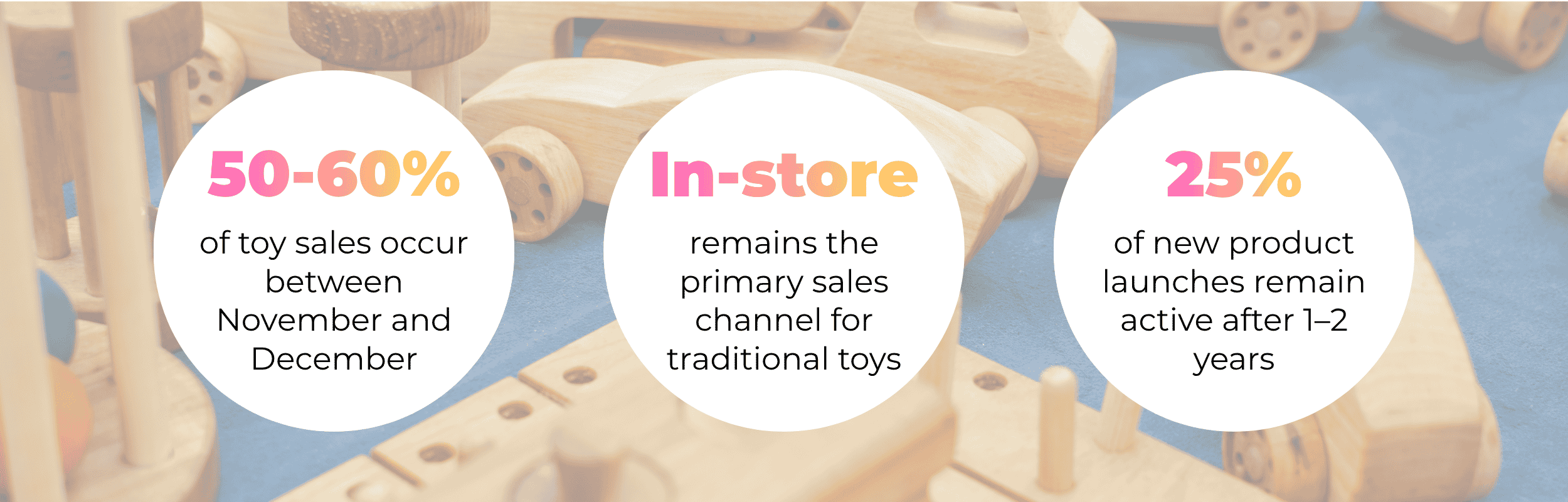
Success is heavily weighted towards Q4, with Christmas driving over half of annual sales (EMR) - Intense competition for physical shelf space
With most sales still happening in-store, visibility in retail remains a primary battleground (Euromonitor) - Strong reliance on early sell-through
Retailers prioritise fast-moving SKUs, limiting tolerance for underperforming launches - Fragmented demand across markets
Preferences vary significantly by country and demographic, requiring localised execution (Expert Market Research) - Regulatory requirements
The EU Toy Safety Directive and evolving compliance standards add cost and complexity (ECHA) - Short product lifecycles
Trends, licensing, and media cycles accelerate product turnover and obsolescence
Where Launches Succeed and Where They Fail
The difference between success and underperformance is driven by execution quality at this stage.
- Distribution coverage
Strong launches secure consistent availability from day one, while gaps in distribution limit early demand capture - Visibility and in-store presence
High-performing launches achieve strong shelf positioning and activation, while poor visibility reduces conversion - Early sell-through
Successful products generate immediate sales momentum, supporting replenishment and retailer confidence; weak sell-through leads to reduced support - Consistency across markets
Scalable launches deliver uniform execution across retailers and geographies, while inconsistency dilutes overall impact
As a result, similar products can deliver materially different outcomes depending on how effectively it is executed in-market.
How Reach Improves NPD Outcomes
Reach addresses a core constraint in European NPD: the gap between insight, execution and shopper engagement. It brings together data, technology and in-market delivery into a single, connected system that drives performance.
From Insight to Action and Engagement
Insight is connected directly to execution, while shopper engagement drives early momentum.
- Visibility of availability, compliance and sell-through at SKU and store level
- Identification of lost sales (out-of-stocks, zero-sales days, underperformance)
- Prioritisation of high-risk stores and missed opportunities
- Experiential and sampling activation drive awareness, trial and conversion
Products are not just present in-store, they perform.
Consistent Execution at Scale
Flexible delivery models ensure execution is both scalable and reliable.
- Consistent delivery across retailers and markets
- Rapid scaling during peak periods such as Q4
- Flexible deployment models allow activity and budget to scale in line with demand, maximising ROI
This reduces the variability that undermines launch performance.
Technology That Drives Performance
Our tech stack connects data, field teams and execution in real time.
- Alerts flag availability and compliance issues early
- Image recognition validates shelf conditions and share of shelf
- KPI tracking measures performance at store, SKU and campaign level
- Dynamic prioritisation directs focus to highest-impact actions
This turns insight into continuous in-store improvement.